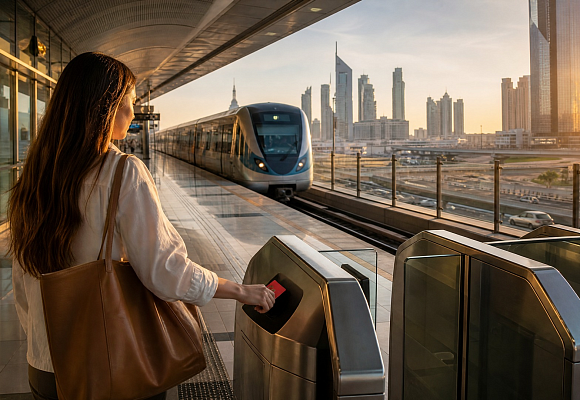
Navigating Public Transport in Dubai: Metro, Buses, and Taxis

One of the first questions newcomers ask is whether you need a car in Dubai. The honest answer: it depends on where you live and work, but you will need one far less often than people assume. Dubai public transport is clean, cheap, air-conditioned and easy to use once you understand two things — the Nol card and the zone system.
This guide covers everything you need to get around Dubai confidently: the Metro, the tram, buses, abras, taxis and ride-hailing apps, plus what it all costs and which app to use when.
The system in one minute
Almost everything is run by the RTA (Roads and Transport Authority), and almost everything is paid for with one card. The network includes:
-
Dubai Metro — two driverless lines, Red and Green, the backbone of the whole system
-
Dubai Tram — a short loop through Dubai Marina and JBR, connected to the Metro
-
RTA buses — city routes, express routes, feeder buses to Metro stations, night routes and intercity services
-
Marine transport — abras across Dubai Creek, water buses and ferries
-
Taxis and ride-hailing — RTA taxis, Hala, Careem and Uber
Everything except the ride-hailing apps runs on the same payment card and the same fare rules. That is the part that makes it simple.
The Nol card: your key to the whole network
The Nol card is a rechargeable contactless card, similar to London's Oyster card or New York's MetroCard. You tap in when you start a journey and tap out when you finish. No cash is accepted at Metro gates or on buses.
There are four main types:
|
Card |
Roughly who it's for |
Notes |
|
Red Ticket |
Short visits |
Paper ticket, reloadable for a limited number of trips, slightly higher per-trip fare |
|
Silver |
Most residents and regular riders |
Around AED 25 including AED 19 of credit; standard fares; valid for years |
|
Gold |
Anyone who wants the front premium cabin |
Same purchase price, but double the fare per journey |
|
Blue (personal) |
Students, seniors, people of determination |
Registered to you, concession fares, balance recoverable if lost |
A few rules that save you money and frustration:
-
Fares are zone-based, not distance-based. Dubai is divided into fare zones, and you pay according to how many you cross.
-
Standard Silver fares are approximately AED 3 for one zone, AED 5 for two zones and AED 7.50 for three or more. Gold is double that.
-
Keep at least AED 7.50 on the card. Gates will not open below the maximum possible fare, even for a short trip.
-
Always tap out. Forget, and the system deducts the maximum fare for that journey.
-
Transfers within roughly 30 minutes count as one journey. Metro to bus to tram is charged as a single trip by total zones crossed, not per vehicle.
-
There is a daily cap — around AED 14 on Silver and Blue cards. Once you hit it, further travel that day is effectively free.
You can buy and top up cards at station machines, ticket offices, RTA service centres and through apps including nol Pay, RTA Dubai and DubaiNow.
Dubai Metro guide
The two lines
The Red Line is the long one, running from Centrepoint in the northeast along Sheikh Zayed Road and out to the southwest, where it splits — one branch continuing to Expo City via the Route 2020 extension. It passes almost everything a newcomer needs: the airport, Deira, Downtown Dubai, Business Bay, Mall of the Emirates, Dubai Marina and Jebel Ali.
The Green Line is shorter and stays in the older parts of the city, running through Deira and Bur Dubai roughly along Dubai Creek. It is the line for the souks, Al Fahidi and the historic district.
The two lines cross at Union and BurJuman, where you can switch without leaving the paid area.
A third line, the Blue Line, is under construction and expected to open around 2029, connecting areas including Dubai Creek Harbour, International City, Silicon Oasis and Academic City. It is not running yet, so ignore any map that shows it as operational.
Timings
The standard schedule is roughly:
-
Monday to Thursday and Saturday: 05:00 – midnight
-
Friday: 05:00 – 01:00
-
Sunday: 08:00 – midnight
Trains come every 2–4 minutes at peak times and every 5–7 minutes off-peak. Hours are usually extended for Eid, New Year and major events, and RTA announces changes in advance. The practical advice: do not plan a night out around catching the last train. Leave a buffer or budget for a taxi.
Good to know
-
Gold Class is the front cabin — quieter, more space, double fare. Worth it on a long commute at rush hour.
-
The Women and Children cabin is at the front of every train at no extra cost. Men entering it face a fine.
-
Eating, drinking, chewing gum and sleeping on the Metro are all finable offences, as is sitting on the floor.
-
Airport access: Red Line stations serve DXB Terminals 1 and 3 directly. Terminal 2 needs a taxi or shuttle.
-
Free Wi-Fi is available across the network, and every station has lifts and step-free access.
Trams, monorail and the water routes
The Dubai Tram runs through Dubai Marina, JBR and Al Sufouh, connecting to the Red Line at Sobha Realty and DMCC stations. It uses the same Nol card and generally runs from around 06:00 to 01:00, starting later on Sundays. Note that, unlike on the Metro, you tap at the platform gates rather than on board.
From the tram you can connect to the Palm Jumeirah Monorail, which runs along the Palm trunk to Atlantis. The monorail uses separate tickets rather than Nol.
Then there is the part of the network people forget: abras. The traditional wooden boats crossing Dubai Creek between Deira and Bur Dubai cost a couple of dirhams and are one of the best-value experiences in the city. Modern water buses and the Dubai Ferry cover longer, more scenic routes and accept Nol.
Buses: the network that fills the gaps
Dubai's bus network covers a large majority of urban areas and does the essential job of connecting neighbourhoods to Metro stations. Routes are categorised by prefix:
-
Numbered routes for standard city services
-
F for feeder buses linking communities to Metro and tram stations
-
X for express routes
-
C for central business district services
-
N for night buses
-
E for intercity routes to Sharjah, Abu Dhabi and the northern emirates
All buses are cashless — tap your Nol card on entry and exit. Many bus stops in Dubai are air-conditioned, which matters a great deal in July.
There is also Dubai Bus on Demand, an app-booked minibus service operating in selected zones. You book a seat, walk to a virtual stop, and the route adapts to bookings. Fares are modest and the same daily Nol cap applies.
Taxis and ride-hailing
Taxis are plentiful, metered and regulated, and by global standards they are inexpensive.
-
Starting fare in the city is around AED 12, rising for night pickups.
-
Airport pickups start higher, around AED 25.
-
Per-kilometre rates sit at roughly AED 2.19–2.26, plus small waiting charges in traffic.
-
You can pay by cash, card or Nol.
For app booking you have three main options:
-
Hala (inside the Careem app) books official RTA taxis at meter rates, with no surge pricing. For most residents it is the cheapest app-based option.
-
Careem also operates its own fleet with dynamic pricing, plus food delivery, bike rental and payments in the same app.
-
Uber offers upfront fixed fares, which can work out better on long trips in heavy traffic, and premium vehicle classes.
There are also specialist services: Ladies Taxis with female drivers, family taxis with extra seats, accessible vehicles for people of determination and limousine services.
Getting around from Dubai Production City (IMPZ)
If you live in the Production City area — as You&Co residents do — here is the practical picture.
The nearest Metro station is Jumeirah Golf Estates on the Red Line's Route 2020 branch, around ten minutes away by car. RTA feeder buses, including route F38, connect the station with Dubai Production City and Dubai Sports City, so a Metro commute is entirely doable: feeder bus to the station, then Red Line towards Downtown, Marina or the airport.
In practice most residents mix modes. Metro for long cross-city trips at rush hour, when Sheikh Zayed Road is slow. Taxi or Careem for short local runs, evenings out and anything with luggage or shopping. Dubai International Airport is around twenty minutes by car, and Dubai Marina beach is about twenty-three.
Apps you will actually use
-
S'hail — RTA's official journey planner across all modes
-
RTA Dubai — fines, parking, Salik, vehicle services
-
nol Pay — check balance and top up your card from your phone
-
Careem / Uber — rides, and much more in Careem's case
-
Google Maps — surprisingly good for Dubai public transport routing, and the default for most residents
Etiquette and rules worth knowing
-
No eating or drinking anywhere in the Metro system, including stations.
-
Priority seating for women, children, seniors and people of determination is enforced.
-
Keep bags off seats during rush hour.
-
Photography of other passengers without consent is taken seriously in the UAE.
-
Fines are real and issued on the spot, so tap in and out properly.
The verdict: do you need a car?
If you live near a Metro station and work along the Red Line corridor, you can comfortably live without one. If you live in a community set back from the Metro, the realistic setup is public transport for commuting plus taxis for everything else — which still works out far cheaper than car ownership once you count insurance, Salik tolls, parking and fuel.
The other factor is what your building already gives you. A community with a coworking space, gym and pool on site removes a surprising number of journeys from your week. At You&Co in Dubai Production City, work, workouts and social life all happen in the same building, so transport becomes something you use for exploring the city rather than surviving it. Add a Nol card for weekends, and Dubai opens up without a single car payment.